Anova Two Way Calculator Online Upload Data
Enter sample information directly
Balanced two Factor ANOVA with Replication - several values per jail cell. The information should be separated by Enter or , (comma).
ANOVA without Replication - 1 value per jail cell.
The tool ignores empty cells or non-numeric cells.

Data
Models
There are many possible models, this computer deal currently simply with the following balanced models:
- Fixed effect model (A-Fixed, B-Fixed), no repeats - both factors are stock-still.
- Mixed result model (A-Random, B-Fixed), no repeats - factor A is random, gene B is fixed, each subject is measured only once.
- Mixed event model (A-Fixed, B-Random), no repeats - cistron A is fixed, factor B is random, each discipline is measured only once.
- Random event model (A-Random, B-Random), no repeats
- Mixed repeated measures (A-Fixed, B-Repeated) - factor A is stock-still, factor B uses the aforementioned subject for all the categories.
You may apply data with replications, or data without replications.
What is balanced model?
The balanced design has the same number of observations in each prison cell - each combination of cistron.
Currently this figurer supports merely the balanced design.
When the model is unbalanced, information technology causes correlation betwixt the factors and the interaction if it is proportional, and also betwixt the factors if it is unbalance but not proportional.
hence you lot don't know how to divide the shared sum of squares between the two factors.
At that place are several methods how to deal with the shared sum of squares.
Type I - sequenceial, the get-go some of squares (SS) you lot calculate get the shared some of squares, in this case the order is affair!
Type 2 - bourgeois, it assumes at that place is no interaction between the factors, it ignores the shared SS betwixt the factors. Blazon III - it assumes in that location is interaction between the factors, it ignores all the shared SS between the factors and between the factors and the intercation.
Targets
The two way ANOVA examination checks the following targets using sample data.
- Checks if the departure between Factor A averages of two or more categories is meaning
- Checks if the difference between Factor B averages of two or more categories is pregnant
- Checks if there is an interaction between Cistron A and Cistron B
When performing ANOVA test, we try to determine if the difference between the averages reflects a real difference betwixt the groups, or is due to the random noise within each group.
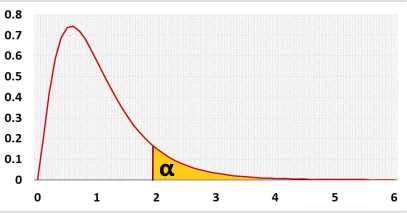
The F statistic represents the ratio of the variance between the groups and the variance inside the groups. Unlike many other statistic tests, the smaller the F statistic the more probable the averages are equal.
Correct-tailed F test, for ANOVA test you tin can use simply the right tail. Why?
Hypotheses
Factor A: H0: μ1 = .. = μa
There is no difference in the means of variable A categories.
Factor B: H0: μ1 = .. = μb
At that place is no difference in the means of variable B categories.
H0: Interaction(AiBj) = 0 (∀ i = 1 to a, j = 1 to b)
There is no interaction between variable A and variable B, i.east., for all the cells, the effect of variable A on the cells' means is non depend on the event of variable B, and vice versa.
Test statistic
| Fixed Model | Mixed Model | Random Model | Mixed Repeated | ||||
| FA= | MSA | FA= | MSA | FA= | MSA | FA= | MSA |
| MSE | MS AB | MS AB | MS SWA | ||||
| FB= | MSB | FB= | MSB | FB= | MSB | FB= | MSB |
| MSDue east | MSE | MS AB | MS BSWA | ||||
| FAB= | MSAB | FAB= | MSAB | FAB= | MSAB | FAB= | MSAB |
| MSE | MSDue east | MSEastward | MS BSWA | ||||
F distribution
Assumptions
- The dependent variable is continuous (ratio or interval)
- Two categorical contained variables
- Independent observations (no repeated measure)
- The residuals distribution is normal
- Homogeneity of variances, a like variance for each cell
Required Sample Information
 | Sample data from all compared groups |
Parameters
a - the number of categories in variable A, number of rows.
b - the number of categories in variable B, number of columns.
ni - sample side of category i of variable A (row i).
nj - sample side of category j of variable B (column j).
ni,j - sample side of cell i,j (row i, column j). In the residue ni,j=north/(a*b)
northward - overall sample side, includes all the groups (Σni,j, i=one to a, j=one to b).
Ȳi - boilerplate of all the observations of category i of variable A (row i).
Ȳj - average of all the observations of category j of variable B (cavalcade j).
Ȳ - overall boilerplate (ΣYi,j,g / n, i=1 to a, j=i to b, 1000=i to northwardi,j).
Repeated measures ANOVA
s - represent the order of subject in category i (subject area 1 in category 1 is different than subject field 1 in category 2)
sub - number of subjects per jail cell, cell is one combination of variable A and variable B. For the residuum design: N=a*b*sub.
Ȳi,s - subject'southward average, ΣYi,j,south for subject area i,s ,the average of all the observations of subject southward of category j of variable B (cavalcade j).
Ȳ - overall average (ΣYi,j,s / n
Results calculations
Sum of squares
The sum of squares accumulates the squared differences related to the result we try to estimate.
SSA - the squared differences related to the effect of variable A. Y'all compare the boilerplate of every category to the full average. The same value every bit the sum of squares between groups in 1 style ANOVA.
SSB - the same as SSA, for variable B.
SSAB - the squared differences related to the effect of the combination of variable A and variable B in each cell, Since we try to understand the influence of the interaction AB, the interaction of the specific value of variable A and the specific value of variable B, we take the average of each cell, remove the influence of variable A and variable B, and compare to the total average.
A effect = Ȳi - Ȳ
B effect = Ȳj - Ȳ
AB effect = Jail cell average - A effect - B effect - Full boilerplate.
= Ȳi,j - (Ȳi - Ȳ) - (Ȳj - Ȳ) - Ȳ.
= Ȳi,j - Ȳi - Ȳj + Ȳ.
Take the square of each difference
Ȳi,j - Ȳi - Ȳj + Ȳ)ii.
Count the square differences of each value in the cell, hence multiply past the sample size of each cell (ni,j).
SSAB=Σi aΣj bni,j(Ȳi,j - Ȳi - Ȳj + Ȳ)2
Fixed and Random Effects
The fixed and random effects are related to the independent variables ().
Fixed Result
The effect is constant across individuals.
- The categories of the variable contains the entire categories' list
- The effect of this variable is interesting. The difference between the categories is important
- There is no know pattern on the difference between the categories
Random Effect
The effect vary across individuals, the individuals may be people, products.
- The categories' listing is only a sample from the entire categories' list
- The effect of this variable is not interesting past itself. The difference betwixt the categories is not important.
- There is no know design on the difference betwixt the categories
Example: collecting data from several schools.
A sample from the entire groups' population.
There is no pattern about the difference between the schools, and if at that place will be a blueprint, it will be another cistron, like school's size.
Each school is not important by itself.
When you alter the interaction field or the model, the post-obit ANOVA tabular array and diagram will exist adapted!
ANOVA tabular array - with interaction
| Source | Degrees of Liberty (DF) | Sum of Squares (SS) | Mean Square (MS) | F statistic | p-value |
|---|---|---|---|---|---|
| Between subjects Between the subjects when ignoring gene A | DFBS = a*sub - 1 | | |||
| Cistron A (rows) Between the categories of cistron A | DFA = a - one | SSA = Σi ani(Ȳi-Ȳ)2 | MSA = SSA / DFA | FA = MSA / MSE | P(10 > FA) |
| Subject within A | DFSWA = a*(sub - 1) | SSSWA = SSBS - SSA | SSSWA / DFSWA | ||
| Within subjects | | | |||
| Factor B (Columns) Between the categories of gene B | DFB = b - 1 | SSB = Σj bnj(Ȳj-Ȳ)two | MSB = SSB / DFB | FB = MSB / MSE | P(x > FB) |
| Interaction AB Betwixt the cells afterwards reducing factor A and cistron B effects | DFAB = (a - ane)(b - 1) | SSAB=Σi aΣj bnorthi,j(Ȳi,j - Ȳi - Ȳj + Ȳ)2 | MSAB = SSAB / DFAB | FAB = MSAB / MSE | P(x > FAB) |
| B*Subject within A | DFBSWA = a*(sub - 1) | SSBSWA = SSWS - SSB - SSAB | |||
| Error Within the cells | DFEastward = due north - a*b | SSE=Σi aΣj bΣthou ni,j (Yi,j,thousand - Ȳi,j)2 | MSEastward = SSE / DFE | ||
| Error Within the cells | DFDue east = n - a - b + 1 | SSE=Σi aΣj bΣk northi,j (Yi,j,k - Ȳi - Ȳj + Ȳ)ii | MSE = SSEast / DFE | ||
| Total All the deviations from the average | DFT = northward - ane | SST=Σi aΣj bΣk ni,j (Yi,j,g - Ȳ)two SST=Sample Variance*(northward-1) SST=SSA+SSB +SSAB +SSE | MSE = S2 = SST / (northward - one) |
Sum of squares diagram - with interaction
In the following diagram you may see the differences per each observation Yi,j,thousand that used to calculate the sum of squares.
A effect: Ȳi - Ȳ.
B effect: Ȳj - Ȳ.
Interaction result (AB): Yi,j - Ȳi - Ȳj + Ȳ.
Between Subjects outcome: Yi,j,due south - Ȳi,s.
Inside Subjects effect: Ȳi,southward - Ȳ.
SSSWA = SSBS - SSA.
SSBSWA = SSWS - SSB -SSAB.
Total effect: Between Subjects + Inside Subjects.
Interaction effect (AB): Yi,j - Ȳi - Ȳj + Ȳ.
Fault: Yi,j,k - Ȳi,j.
Fault: Yi,j,k - Ȳi - Ȳj + Ȳ.
Total outcome: Yi,j,k - Ȳ.
Source: https://www.statskingdom.com/two-way-anova-calculator.html
0 Response to "Anova Two Way Calculator Online Upload Data"
Post a Comment